Find the value stream before you add AI
Most AI use cases are picked by asking people what they would like automated. I am building ValueAI to start somewhere else: map where the time actually goes, from four kinds of evidence, then decide where AI belongs.
Ask a department which tasks it would like AI to take over and you get a wish list. Wish lists are biased toward tasks people find boring, which is not the same as tasks that slow the business down. The expensive part of most processes is not a step. It is the wait between steps, the handoff that loses context, and the rework when something comes back.
Lean manufacturing has had a tool for this for decades: value stream mapping. Draw every step, every wait and every handoff, measure them, and the waste becomes visible. The problem is that a proper value stream map takes weeks of workshops, so it is done rarely and goes stale quickly. That sounded like exactly the kind of rationed work AI should make routine.
Four kinds of evidence
So I am building ValueAI: AI-assisted value stream mapping for any process, in any function. The core idea is that no single source tells the truth about a process. You need several, and the disagreements between them are where the insight is.
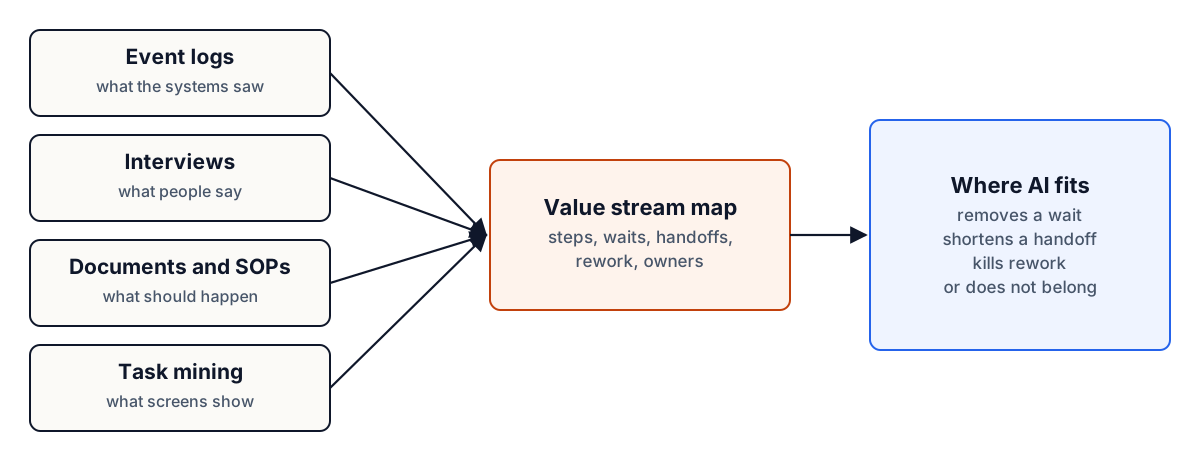
Figure 1. Four kinds of evidence combine into one value stream map. Only then do you ask where AI fits, and sometimes the answer is nowhere.
| Evidence | What it captures well | Its blind spot |
|---|---|---|
| Event logs (process mining) | Real timestamps, real waits, real loops | Only what happens inside systems |
| Interviews | Why things happen, workarounds, judgement | Memory and politics |
| Documents and SOPs | How the process is supposed to work | Often out of date |
| Task mining (screens) | The clicking and copying between systems | Says nothing about why |
Design choices
| Choice | Decision | Reason |
|---|---|---|
| Profiles | One per business function (finance, engineering, HR and so on) | “Manufacturing versus transactional” was too coarse to be useful |
| Canvas | React Flow | A value stream is a graph; it should feel like one |
| Backend | Python, FastAPI, FastMCP, SQLite | Simple to run, and the MCP server lets agents read and update maps |
| Delivery | Web app and a Tauri desktop app | Same product in the browser and on the desktop |
What it changes in an AI programme
The output is not “use AI here”. It is a map that says where the time goes, so each candidate use case can be judged on one question: does it remove a wait, shorten a handoff, or kill a rework loop? If it does none of those, it may still be nice to have, but it should not be in the first wave.
It is a simple filter. It is also the one I intend to apply to every use-case list before any scoring matrix comes out.